.png)


Reverse Mortgage Canada: 5 Myths That Keep Homeowners Short Every Month

A lot of Canadians are sitting on a house worth millions and still coming up short every month. That's the tension at the heart of this RealtyChatter episode, and it's why the reverse mortgage question keeps coming up at kitchen tables across the GTA.
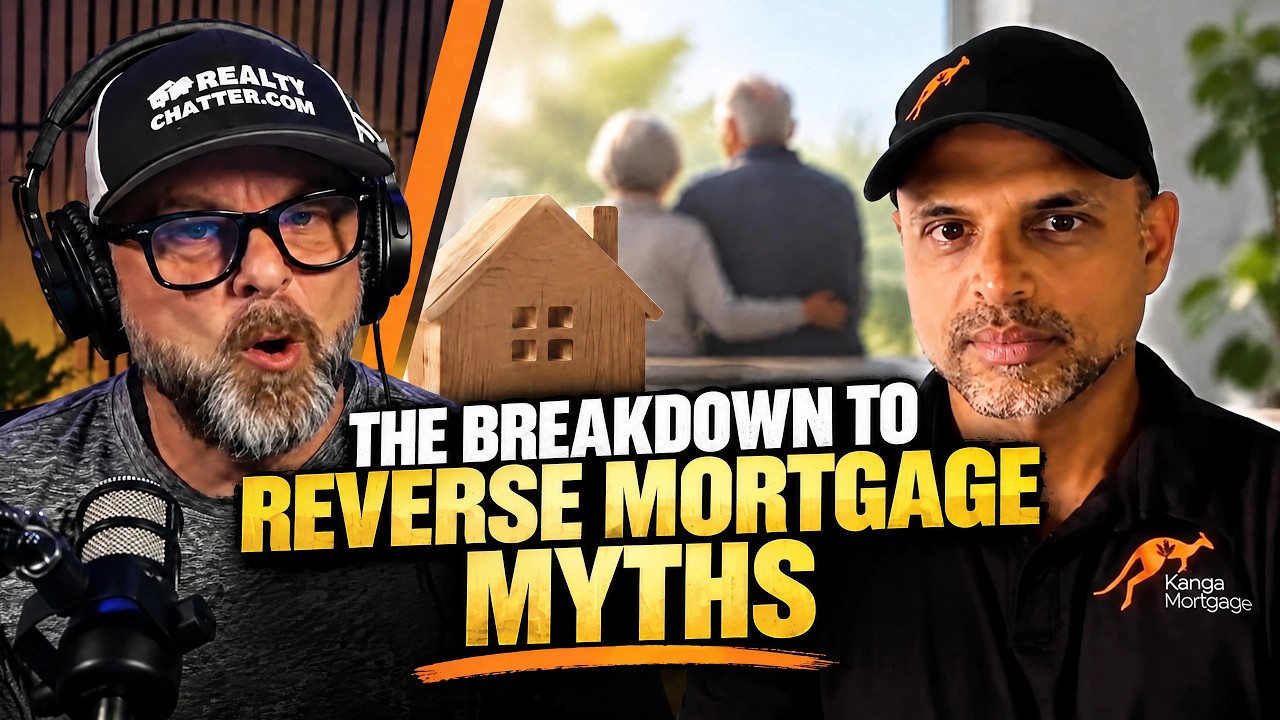
Gary McGowan sat down with mortgage broker Dion Beg of Kanga Mortgage, fresh off a weekend speaking to a room full of homeowners approaching or already in retirement. The same handful of questions came up again and again. Most of them were built on myths. Here's what the reverse mortgage actually looks like in Canada, in plain English.
The $60,000 house that's now worth $2 million
Dion opened his talk with a slide showing how GTA house prices have grown over the decades. Back in 1978, the average purchase price was around $67,000. He watched heads nod across the room as people remembered buying in the 70s for $50,000 or $60,000.
After the presentation, attendee after attendee came up with a version of the same story: "Dion, that house I paid $60,000 for is now worth $2 million or more."
Not everyone is sitting on that kind of gain. Some have an uplift of $500,000, some a million. The question is the same either way: what do you do with that equity, for yourself and for your family? Plenty of families are already gifting $50,000 or $100,000 as an early inheritance to help their kids buy. The reverse mortgage is the other tool that comes up, and it comes wrapped in misunderstandings.
Myth 1: A reverse mortgage won't solve a monthly income gap
Here's the situation Dion sees constantly. Someone's pension and CPP bring in $3,000 a month. To live the retirement they planned, they need $5,000. That's a $2,000 hole, every single month.
What a lot of people don't know is that a reverse mortgage can be set up to feel like one more paycheque. An extra $2,000 can land in the bank account on the first of every month. For a couple who has spent 30 or 40 years paying down a home, that's the difference between getting by and actually enjoying these years.
Myth 2: Reverse mortgage money is taxed like income
This is the question that gets the biggest reaction. If it feels like income, it must be taxed, right? And won't it hurt CPP or OAS?
No on both counts. The money from a reverse mortgage isn't income. It's a loan against your own home. It feels like income because it shows up in your account every month, but because it's a loan, there's no tax on it and it does not affect your other pensions.
As Gary put it on the show: if you missed that, that's tax-free money coming in every month. Dion said a lot of people in the room were pleasantly surprised to hear it.
Myth 3: The bank takes ownership of your house
The fear goes like this: sign a reverse mortgage and you've signed the house over to the bank, and they walk away with it at the end of your life.
That's wrong. You still own the property. The lender is registered on title, the same way TD, Scotiabank or CIBC would be on any regular mortgage. You're the owner. The bank is the mortgagee. Nothing about that changes because the product has the word "reverse" in front of it.
Myth 4: Your family could end up owing more than the house is worth
This is the one that keeps adult children up at night. A reverse mortgage grows over time because interest accumulates. What happens if the balance ends up bigger than the house?
Dion had just walked a client through this exact scenario. Say the reverse mortgage has grown to $1 million, and after the owner passes, the home sells for $800,000. That's a $200,000 shortfall. Under what Dion calls the reverse mortgage no negative equity guarantee, that shortfall is absorbed by the lender. The family and the estate can't be pursued for anything beyond what the property sold for. What gets cleared is the lesser of the mortgage balance or the value of the home.
For anyone worried about leaving their kids with a debt, that's the answer that matters most.
Why the balance rarely gets that high
There's a built-in cushion. With a regular mortgage you can usually borrow up to 80% of your home's value. With a reverse mortgage, Dion says it's typically somewhere between 35% and 55%. Lenders leave a lot of room for the debt to grow from day one.
People also forget the home itself usually keeps appreciating. It's not a case of the loan climbing while the house sits still. The two tend to move together, and the value of the home usually grows faster than the reverse mortgage balance.
Myth 5: If one spouse passes, the house has to be sold
A widow shouldn't have to lose her home on top of losing her husband, and with a reverse mortgage she doesn't. Dion explains that these mortgages are written to the last survivor. If one spouse passes, the other is safe in the home, and the bank can't push them out.
Lump sum, monthly deposits, or both
The last question Gary put to Dion was about flexibility, and this is where a reverse mortgage gets more useful than most people expect.
Say you're approved for $400,000. You don't have to take it all at once. You might take $100,000 now to do renovations and leave the other $300,000 on call, sitting there doing nothing until you need it. Or you can set up part of that $300,000 as a $3,000 monthly deposit into your bank account, so it works like an extra paycheque. The structure bends to fit your life, not the other way around.
What this means if you're helping a parent decide
If you're an adult child watching your parents stretch every dollar while sitting on a paid-off house, this episode is worth 10 minutes of your time. The reverse mortgage isn't the right move for every family. Selling, downsizing and early inheritance gifts are all on the table too. But it deserves a real conversation built on facts, not the myths above.
Start with the numbers: what the home is worth, what the monthly gap is, and what the family actually wants the next 10 to 20 years to look like. Then get a mortgage broker who does this work every day to run the options.
Talk to Dion or Gary
Have 10, 15, 20 more questions? That's normal.
Reach Dion Beg at kangamortgage.ca or on Instagram at @thedionBeg.
If you're weighing a reverse mortgage against selling or downsizing a family home, email Gary McGowan at homes@garyamcgowan.com and he'll help you map out the real estate side.
This post is general information, not personal financial or legal advice. Talk to a licensed mortgage professional about your own situation.


Comments