top of page

Has the Toronto Housing Market Hit Bottom?


The most telling thing in the July 2026 numbers is not that prices fell. It is how little they fell, and what that quietly says about where this market goes next.


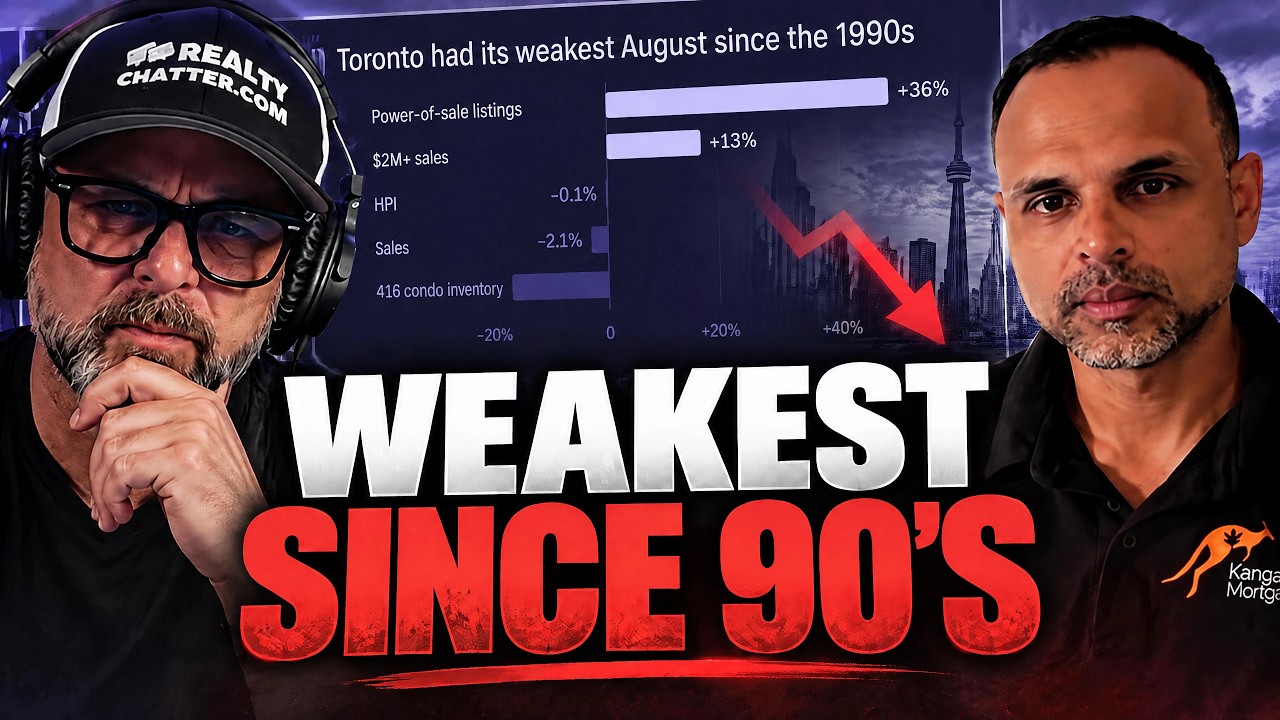
On the latest RealtyChatter episode, Gary McGowan sat down with mortgage broker Dion Beg to pull the July data from the Toronto Regional Real Estate Board apart. About six weeks ago they asked on the channel whether the market had reached the bottom. July did not answer with a clean yes. It also did not say no. Prices have basically flattened, and the supply picture underneath them is shifting in a way most headlines are missing.


Here is the plain-English version, and what it means whether you are buying, selling, or thinking about moving up.


The July 2026 numbers at a glance

Roughly 6,000 homes sold across the GTA in July, down about 1% from the same month last year. That is not a collapse. That is flat.


The number worth staring at is listings. New listings came in at 14,484, down almost 18% year over year. Active listings are down about 12%. So yes, there are fewer buyers in the market right now. But there are also meaningfully fewer homes for them to compete over, and that balance is what holds prices up.


The average GTA price across all property types now sits about 4.5% below last year, knocking on the door of $1 million, a line the average dipped below earlier in 2026 for the first time in years. Historically, when supply tightens like this, prices firm up rather than fall. Dion's read: the monthly drops are getting smaller, and the next few months could tip the year-over-year number back into the black.


One thing to keep in perspective. August is always one of the slowest months of the year for real estate. If sales come in lower next month, that is the calendar talking, not the market breaking. The trend to watch is month over month through the fall.


Why 2026 was not the refinance year everyone predicted

Here is an insight you will not get from a headline. Dion's brokerage just ran their own numbers, and about 60% of their transactions this year are purchases, only 40% are refinances. The whole industry expected 2026 to be a monster refinance year as mortgages came up for renewal. It has not played out that way.


Part of it is banks fighting to keep their existing clients with aggressive renewal rates. But the bigger reason is blunt. A lot of homeowners who want to refinance simply cannot, because the equity they assumed was sitting in their home is not there at today's values. Rolling expensive credit card and car loan debt into a cheaper mortgage only works if the equity exists to borrow against. Right now, for many, it does not. It is not a lack of want. It is a lack of equity.


The move-up window: small condo losses, big detached savings

Average July prices by home type looked like this. Condo apartments around $636,000. Townhouses around $817,000. Semis around $964,000. Detached homes around $1.291 million. All of them down from last year.


But look closer, because this is the part that matters most. The detached price drop is more than double the condo drop. That single gap is the entire story for anyone looking to move up.


Think about what it means in practice. Your condo is worth a little less than it was. The detached house you actually want is worth a lot less. The distance between the two has shrunk.


Dion has had two clients in the past month sell a condo and buy a house. Yes, they each took a small loss on the condo. But the home they were buying had fallen so much further that the math finally made sense. One client bought a detached bungalow in North York this month for $920,000. Three years ago, that same bungalow would have sold for $1.2 to $1.3 million.


If your family has outgrown your space, the jump to the next home is probably smaller than you think it is.


416 versus 905: a $340,000 gap, with two catches


The average detached home in the 416 is sitting around $1.548 million, versus roughly $1.2 million in the 905. That is a $340,000 spread. If you are selling in the Beaches or the Annex and buying in Newmarket, Aurora, or Durham Region, the jump can be even larger.


Before you celebrate, two catches.

First, property taxes. That North York bungalow might carry $3,000 to $4,000 a year in property tax. The same style of home in Durham can run $7,000, $8,000, even $9,000. Lenders build the tax bill into what you qualify for, so a million-dollar budget in Toronto might only stretch to about $970,000 in Durham once the higher taxes are factored in.


Second, land transfer tax, and this one works in your favour when you leave the city. Toronto buyers pay both the provincial land transfer tax and a municipal one on top. Buy outside the 416 and you drop the municipal portion, which saves real money on closing day. Speaking of closing day, most lenders want to see roughly 1.5% of the purchase price in reserve on top of your down payment. On a $1 million purchase with 20% down, that means demonstrating about $215,000, not the $200,000 most people budget for.


What this means if you are buying

Prices are about 4.5% below last year, but your negotiating room is starting to shrink as listings dry up. Average days on market across the GTA is around 32. Detached homes in some pockets are likely closer to 50 or 60 days, and those longer-sitting listings are exactly where your leverage lives. Find the home that has been waiting, and you have room to work.


Waiting for the exact bottom sounds smart, but it usually means competing with everyone else who waited. That is the September conversation, and it is a more crowded one.


What this means if you are selling

The honest part first. Your home will not sell for what it would have last year. Dion will not even start qualifying a seller for their next purchase until they have made peace with the idea that a home worth $1 million last year is a $950,000 home today. That is not personal. That is the market.


Now the tactical part. Sale-to-list ratios are holding around 97%. So if the data says a $1 million listing sells for about $970,000, why list at a million and sit there? Price it at $970,000, get every set of eyeballs shopping in that range, and sell. As Gary puts it on the show: do you want to be on the market, or in the market? Price it to be in it.


More pieces on the chessboard

One last story worth your time. Dion spent more than a decade helping a couple build a portfolio, their own home plus several investment properties. They are separating now, which normally cuts a household's buying power in half. But because they had built up those assets, they had choices. Each of them could sell strategically, fund a strong down payment, and buy a home big enough for their kids, without a painful downsize.


Nobody builds a portfolio planning for that day. But the lesson holds. When you are financially strong is exactly the time to put more pieces on the board, because options are what carry you through the moments you never planned for.


About the Author

Paige Kirkdene is Editor in Chief at RealtyChatter.com. She breaks down the Canadian real estate market for buyers, sellers, and Realtors who want straight answers, not noise. Paige works directly with Gary McGowan, bringing his 20+ years of real estate and training expertise into every article.


Comments


  • LinkedIn
  • alt.text.label.Facebook
  • alt.text.label.Instagram
  • alt.text.label.YouTube

©2026 by Gary A. McGowan

Gary A. McGowan
REALTOR®
Keller Williams Realty Centres,
Brokerage, Independently Owned and Operated
16945 Leslie St. Suite 27-29
Newmarket, ON L3Y 9A2 
905-895-5972


bottom of page