.png)


Consumer Insolvencies Just Hit a 2009 High. Here's What It Actually Means.

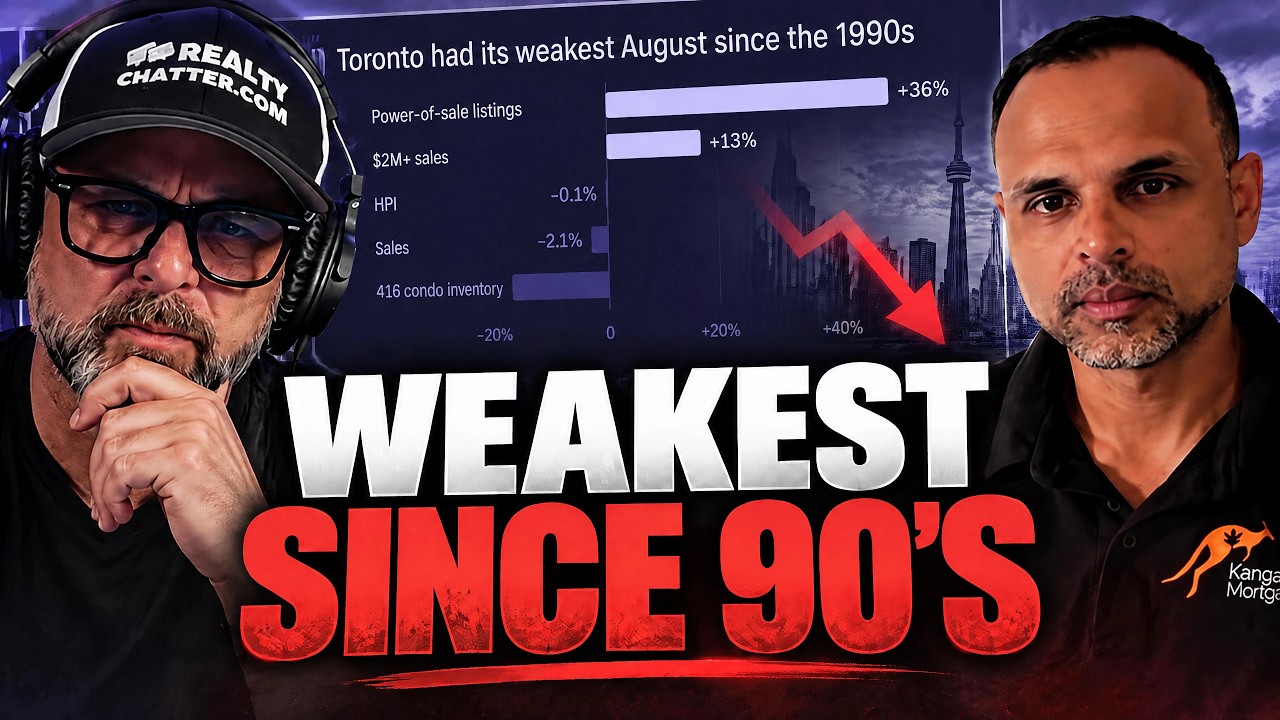
Consumer insolvencies in Canada just hit their highest level since 2009. Power of sale listings across Southern Ontario are up 360% since 2024. And the worst April for home sales since 2003 somehow still showed up as "sales are up year over year" in the headlines.
If you only read the headlines, you would be confused. That is exactly why Dion Beg and I sit down every week to pull apart Ben Rabidoux's Edge Realty report and put it in plain English. Here is what stood out this week.
CPI came in "less bad," but read the fine print
Top line inflation sits at about 2.8%, just under the top of the Bank of Canada's 2% to 3% target range. Sounds fine. But strip out oil and gas and we are actually sitting right at 2%.
That means the entire bump in the top line number is coming from what is happening with oil, Iran, and the Strait of Hormuz. If that situation settles down, even the top line drops back toward the safer 2% mark. Core inflation on a three month annualized basis is only up 0.3% year over year, helped a lot by falling rents and lower interest rates compared to three years ago.
My opinion: do not let a gas-driven inflation number scare you out of reading the rest of the report. The stuff that actually moves the needle on shelter is cooling, not heating.
Sales are "up," but it is still the worst April since 2003
April sales came in up 0.7%. That is technically a year over year increase, but it is also the worst April since 2003 once you take out the COVID years. Think about that. If this April beat last April and this is still the worst in twenty years, that tells you everything about how slow 2025 really was.
Prices have now posted 15 straight monthly declines and are down about 20% from the peak. And here is the part I coach our realtors on constantly. If you are comparing today's numbers to the 2021-2022 peak, you are comparing the wrong numbers. Wipe out 2020 to 2024, look at the five years before that, and take the 30,000 foot view. That is the only way the market makes sense.
Insolvencies are back at 2009 levels
There were 13,400 consumer insolvencies in March. That is the highest since June 2009.
The simple version is this: people's monthly payments have outgrown their ability to pay. For years, a lot of Canadians treated their home like an ATM. Values went up, equity was easy to pull out, and the holiday and the new truck got financed against the house. That works great until the market turns and that equity is not there anymore. Now the bill is coming due.
Power of sales are up 360%, and I checked the live data
GTA power of sale listings are up 70% year over year, and up 360% since 2024. Lawyers I talk to are maxed out, mostly dealing with people who can't close on preconstruction condos.
I jumped into REALM live during the episode. As of today, across about 90% of Southern Ontario, we are sitting at just over 1,200 power of sale listings. In the city of Toronto alone, 213 listings. The range runs from a single parking spot at $50,000 up to a $6.99 million home, with a median around $644,000.
My opinion: this number is going higher before it gets better. The people who locked in 1.8% and 1.9% rates in 2021 are renewing into 4% this year, and not all of them can carry it.
"Developers are drunk"
There were 12,500 rental starts in April. A record by a wide margin. At the same time, REITs are reporting that new tenants are paying less than the tenants who just moved out. Rents are coming down because tenants finally have choices.
So why build into an oversupplied market? Housing starts are a lagging indicator. These decisions got made 18, 24, even 36 months ago because of permitting and timelines. Dion played devil's advocate, and it is fair: these are for-profit companies spending hundreds of millions. Maybe they know something we don't about future immigration policy and where the population lands five years out. Either way, if you own a couple of condos and a 200 unit rental is going up next door, you watch this closely.
How do you measure people leaving the country?
You get creative. One proxy is cell phone deactivations. The one we looked at was public transit ridership in Brampton, which was an epicentre for temporary residents. January ridership went from 3.2 million last year to 2.4 million this year, and the red numbers show a 21% to 30% drop over the last one to two years.
The reason this is trustworthy is that nobody cooked these numbers to make a point. The city was just measuring transit demand. When an unbiased dataset tells the same story, you can actually believe it.
The renewal wave is peaking now
2021 was the biggest purchase year in Canadian history, and most of those mortgages were five year terms. So most of them renew this year. What you are seeing in the renewal data was completely predicted. We are at the peak right now, it should taper toward the end of the year, and it will be mostly done by Q1 next year.
The CRA income verification tool (this is the big one)
Here is the story Dion tells too often. Someone calls him for a refinance, he looks at their income, and there is no way on earth they qualified for the $1.4 million mortgage they are sitting on. Their answer? "My agent and broker just took care of it." Translation: a bad actor created falsified income documents.
In the next 12 to 18 months, a CRA income verification tool is coming that lets lenders confirm income directly with the CRA. If the notice of assessment says $120,000, the CRA confirms $120,000 on the other side. No more faked documents getting people into mortgages they can't afford.
My opinion: this is the most important thing in the entire report. It takes the bad actors out of the equation and puts buyers back on a level playing field. The likely knock-on effect is fewer buyers qualifying at inflated levels, which means fewer transactions and pricing that drifts back toward what people can actually afford. We have been waiting for this in the industry for a long time.
What this means for you
If you are a seller, price for today's market. Not for last year, not for last month, and definitely not for the 2021 peak. The buyer is not paying yesterday's price.
If you are carrying stress, have the conversation now. Sometimes the answer is selling and resetting your credit. Sometimes it is repositioning so you can stay put. Either way, you need to hear reality, even when it is not what you want to hear.
And if you are a realtor, be the expert who knows what to do when a distressed seller calls. Ask the deep questions. If they won't answer them for you, bring in a mortgage broker team who can.
That is what Dion and his team do. If you or a client needs to run the real numbers, reach out.
Data source: Ben Rabidoux, Edge Realty Analytics


Comments